Six months ago, I had a vague plan. I was going to learn digital marketing — not the high-level conceptual overview kind, but the actually-do-things-on-the-internet kind — using only free resources. No expensive bootcamps. No paid courses. Just Google, YouTube, HubSpot, and whatever else I could find that cost absolutely nothing.
I am writing this six months later to give you an honest, transparent picture of what that process looks like. This isn’t a filtered success story where everything goes perfectly; it is an actual, realistic account of the journey.
Phase 1: Heavy Information Consumption (Months 1–2)
The initial phase of self-paced learning must be dedicated to establishing a rock-solid theoretical foundation. If you try to execute campaigns before you understand consumer intent, you will waste valuable time.
Month 1: Building the Google Foundation
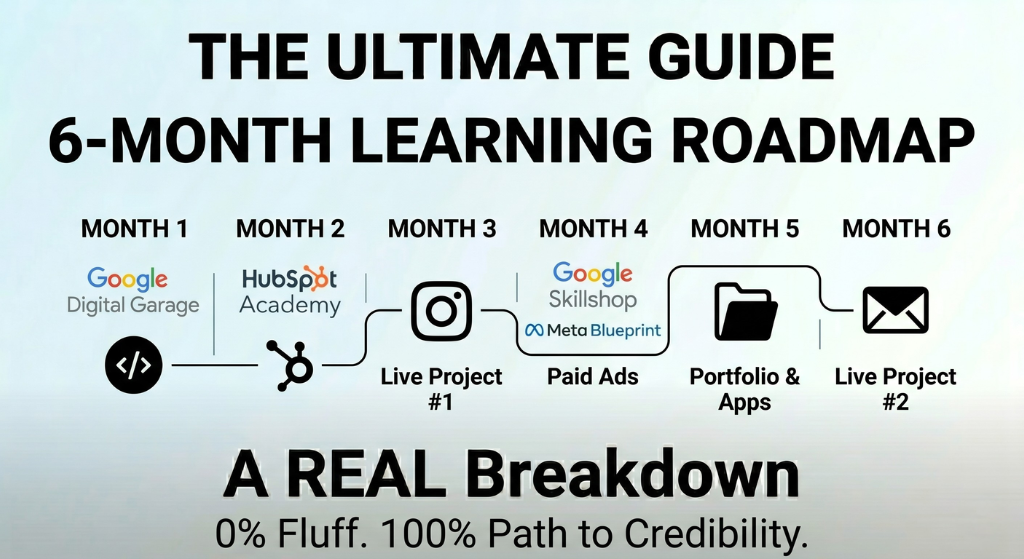
I started by working through the Google Digital Garage certification, specifically the full Fundamentals of Digital Marketing program.
- The Commitment: I dedicated roughly an hour a day after dinner, with slightly longer sessions on weekends, finishing the track in about three weeks.
- The Scope: It covers SEO, social media architecture, email marketing, analytics, and advertising basics. While the content is foundational rather than hyper-focused, it is the exact framework a beginner needs to map out the industry. I successfully passed the certification exam on my first attempt.
Month 2: Deep Diving with HubSpot Academy
Once I understood the macro-environment, I moved to HubSpot Academy to acquire depth in specific execution styles. I completed two distinct tracks:
- Inbound Marketing Certification
- Content Marketing Certification
The content marketing track provided a massive mental shift. It forced me to stop viewing online content as something you produce simply to sell a product, and start viewing it as a mechanism to build a loyal audience that you can eventually sell things to. That structural reframe is incredibly significant.
Phase 2: Shifting from Theory to Real-World Execution (Month 3)
By the end of month two, I fully understood the theory. I knew what SEO was, I knew how email funnels were architected, and I understood the basics of Meta Ads targeting. However, without practical experience, the theory was beginning to feel abstract and hard to retain.
In month three, I took a calculated step: I offered to manage the Instagram presence of a friend who ran a small online store.
The Arrangement: This was explicitly a non-paid, learning-based partnership. I handled her content calendar and basic analytics reporting in exchange for direct access to a live account and raw data.
Running a live account—even a small one—teaches you operational realities that no online course ever mentions:
- Creating high-quality, consistent content is significantly harder than it sounds.
- Organic engagement rates vary wildly, and not always for reasons a textbook can explain.
- What data analytics tells you and what your gut tells you are sometimes completely different; balancing the two is a skill you only develop through real-world friction.
Phase 3: Platform Mechanics & Portfolio Construction (Months 4–5)
Month 4: Mastering Paid Traffic Infrastructure
With organic social media experience underway, I shifted to paid advertising infrastructure. I utilized two major, zero-cost corporate platforms:
- Google Ads: Mastered through Google Skillshop, learning keyword bidding structures, Search campaigns, and Display mechanics.
- Meta Ads: Mastered through Meta Blueprint, learning the backend technicalities of Ads Manager, pixel tracking, and custom audience creation.
Because I didn’t have personal capital to fund ad spend, I learned the platform mechanics theoretically, then set up small, low-budget test campaigns on my friend’s store during small promotions to observe how the algorithmic auction system responded to actual live spending.
Month 5: Building a Minimalist Portfolio
By month five, I had tangible metrics to showcase. I built a simple portfolio—not a fancy, paid website, but a highly organized Google Doc featuring:
- Clean screenshots of the account dashboards.
- Hard numbers tracking the growth and engagement changes.
- Clear, concise explanations of my strategic hypotheses and the results.
Armed with this document, I applied for two junior social media coordinator roles and one digital marketing assistant position. I received one response: an interview for the assistant role. While I didn’t land the job (they chose a candidate with six months of formal agency experience), the interview gave me massive confidence and specific, actionable feedback.
Phase 4: Scaling Up and Diversifying (Month 6)
In my final month, I looked to diversify my portfolio. I approached a local, small non-profit organization that needed support with their email newsletter and pitched the exact same arrangement: free, highly disciplined operational help in exchange for real platform access.
By this stage, my operational speed and execution quality were noticeably superior to my day-one efforts. I was faster, making fewer obvious technical mistakes, and I knew exactly what strategic questions to ask the stakeholder before writing a single line of copy.
The 6-Month Timeline Checklist
If you want to replicate this exact roadmap, expect a timeline that looks like this:
The Honest Verdict
Six months of free resources combined with aggressive, unpaid practical application successfully brought me to a point where I am credibly competing for entry-level roles in the digital marketing industry.
I haven’t landed a full-time corporate role yet, but I transformed from someone who knew absolutely nothing about the backend of the internet into a professional with a functional portfolio, real case studies, and solid references from two live clients.
The high-quality educational resources are out there, and they are entirely free. What they cannot provide is the personal discipline required to do actual, uncompensated work to build your case studies before anyone will trust you with a paycheck.