Data science has become one of the most in-demand skill sets in the global job market. The challenge for most learners is that the field is broad, the terminology is often confusing, and the sheer number of courses available makes it difficult to know where to start — or which courses actually translate into employable skills.
This list cuts through the noise. Every course below is either fully free to audit or freely accessible, and each has a direct track record of helping learners transition into data-related roles. They are organized by learning level so you can identify exactly where to enter based on your current background.
Beginner Level — No Technical Background Required
1. Google Data Analytics Professional Certificate (Coursera)
This is the most accessible entry point into data analytics for complete beginners. Developed by Google, it covers the full analyst workflow: spreadsheets, SQL for querying databases, Tableau for visualization, and R for basic statistical analysis. The certificate is widely recognized by employers and can be audited free on Coursera. Expect 6 months at around 10 hours per week.
2. IBM Data Science Professional Certificate (Coursera)
IBM’s 10-course series provides a broader foundation than Google’s certificate, covering Python, data visualization, machine learning basics, and a capstone project using real datasets. It is particularly strong on the Python programming side, which is essential for advancing further in the field. Audit for free on Coursera.
3. Data Science: Foundations Using R Specialization — Johns Hopkins (Coursera)
For learners who prefer R over Python, Johns Hopkins University’s series — originally developed for the massive open course era — remains one of the most rigorous beginner-to-intermediate tracks available. It includes statistical thinking, reproducible research, and exploratory data analysis. Fully auditable for free.
Intermediate Level — Some Coding or Math Background Helpful
4. Machine Learning Specialization — Andrew Ng / Stanford (Coursera)
This is the definitive entry point into machine learning. Andrew Ng’s ability to explain complex mathematical concepts clearly makes this course accessible even to learners with only basic calculus. The updated version uses Python and covers supervised learning, neural networks, and unsupervised learning. Free to audit — one of the most important courses on this list.
5. Fast.ai — Practical Deep Learning for Coders
Fast.ai takes a top-down, practical approach that is radically different from most academic machine learning courses. You build working deep learning models in the first week before being walked through the theory. It is entirely free, requires no enrollment, and the community support is exceptional. Best for learners who want to move fast and build things.
6. CS50’s Introduction to Artificial Intelligence with Python — Harvard (edX)
Harvard’s CS50 brand carries enormous weight on a resume. This AI-specific course covers search algorithms, knowledge representation, machine learning, and neural networks using Python. It is free to audit on edX, and the optional paid certificate is relatively affordable. Completing this course signals serious technical credibility to employers.
7. Applied Data Science with Python Specialization — University of Michigan (Coursera)
Michigan’s 5-course specialization is one of the most practical intermediate tracks available. It emphasizes pandas, matplotlib, scikit-learn, and network analysis using real-world datasets. The course focuses heavily on applying skills rather than pure theory, which maps closely to what actual data analyst roles require day-to-day.
Advanced and Specialized Tracks
8. Deep Learning Specialization — Andrew Ng / DeepLearning.AI (Coursera)
The natural continuation from the Machine Learning Specialization. Covers convolutional neural networks, sequence models, and transformer architectures. This course is the standard preparation path for machine learning engineer roles. Free to audit; the certificate is paid but optional.
9. SQL for Data Science — University of California Davis (Coursera)
SQL remains one of the most universally required technical skills in data roles — including roles that are otherwise non-technical. This course is specifically designed to teach SQL from a data science perspective rather than a database administration perspective. Compact, practical, and free to audit.
10. Kaggle Learn — Micro-Courses (Free)
Kaggle is the world’s largest data science competition platform, and their free micro-courses are among the most practical resources available. Topics include Python, Pandas, Machine Learning, Data Visualization, SQL, and Natural Language Processing. Each course takes 4–8 hours and is entirely project-based. Kaggle certificates are recognized in the industry and the platform’s competition leaderboards are a direct portfolio signal to employers.
How to Build a Portfolio Alongside These Courses
Completing courses alone is rarely sufficient to land a data science role. Employers want to see applied work. As you progress through these courses, build a GitHub repository containing at least 3–5 projects that demonstrate end-to-end data work:
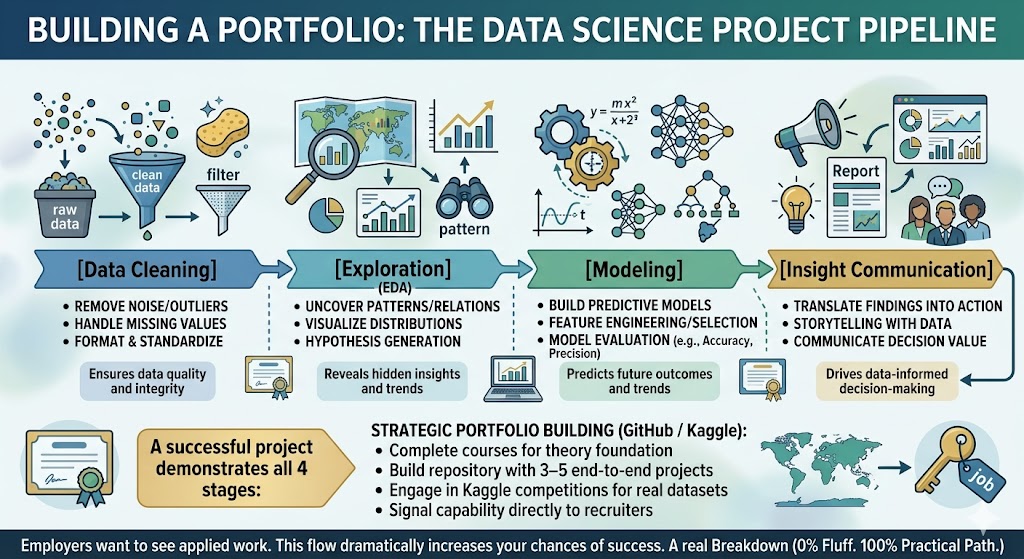
Kaggle competitions are an excellent source of structured project practice with real datasets to signal your capability directly to recruiters