LinkedIn has become the primary professional discovery platform for recruiters worldwide. Over 87% of recruiters use it as their main sourcing tool, and with the platform now exceeding 1 billion members, the opportunity is enormous—but the noise is deafening.
Most LinkedIn profiles, even those belonging to genuinely qualified professionals, are completely invisible. They are vague, passive, and written like an outdated resume. The profiles that actually generate inbound interview requests are built on an entirely different logic: search optimization and proof of impact.
This guide breaks down every critical section of your profile and explains exactly how to stand out.
Your Profile Photo and Banner
Your profile photo is the first anchor point of digital trust. Profiles with clear photos receive dramatically more profile views and connection acceptances than those without. You do not need a luxury studio shoot; a high-resolution smartphone photo taken against a clean, neutral background with solid natural lighting and professional attire is perfectly sufficient.
The banner image (the background canvas behind your photo) is almost universally ignored and left as LinkedIn’s default gray-blue gradient. This is prime real estate. Use this space to signal your professional field visually: showcase a clean minimalist graphic, highlight a portfolio project, or use a branded background that immediately communicates your industry context.
The Headline: Your Most Critical SEO Field
LinkedIn’s default setting sets your current job title as your headline. This is a massive mistake. Your headline follows your name everywhere on the platform—in search results, connection requests, post comments, and recruiters’ candidate feeds. It needs to work as a standalone value proposition, not just an administrative label.
LinkedIn’s search algorithm weights the headline heavily. Pack it with the exact, high-intent keywords recruiters in your field search for.
- Instead of: Software Engineer at XYZ Company
- Write: Software Engineer | Python & Cloud Infrastructure | Open to Remote Roles
- Instead of: Marketing Graduate
- Write: Digital Marketing | Content Strategy & SEO | Helping Brands Grow Organically
The About Section: Tell a Human Story
Most About sections read like a robotic, third-person biography or a dry list of software tools. This approach wastes the most-read narrative block on your profile. Write your About section strictly in the first person, and structure it around three simple, intentional beats:
- The Core Skillset: What you do and what you are specifically excellent at executing.
- The Professional Driver: What problem, industry trend, or psychological narrative genuinely interests you.
- The Current Trajectory: What you are looking for or building right now.
Formatting Tip: End with a clear call to action (e.g., how to reach you directly via email). Keep the entire summary between 200 and 300 words, using short paragraphs and frequent line breaks. Dense, unbroken blocks of text are skipped entirely by users browsing on mobile devices.
Experience: Accomplishments Over Responsibilities
The single most impactful improvement you can make to your profile is rewriting your career experience bullet points.Instead of describing what your static job responsibilities were, focus exclusively on what you accomplished and changed while in that role.
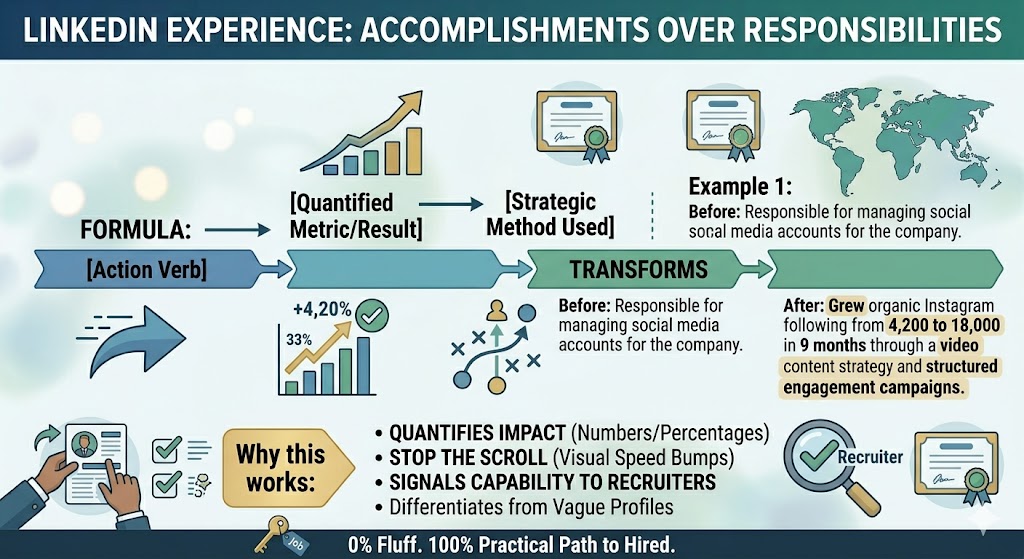
- Before: Responsible for managing social media accounts for the company.
- After: Grew organic Instagram following from 4,200 to 18,000 in 9 months through a consistent video content strategy and structured engagement campaigns.
Wherever possible, quantify your professional history with hard numbers, percentages, or clear before-and-after comparisons. Recruiters skim profiles at high speed; specific numbers act as visual speed bumps that stop the scroll.
The Featured Section: Your Living Portfolio
The Featured section appears prominently near the top of your profile and allows you to pin external links, media, and documents. This section is an incredibly powerful differentiator because the vast majority of users leave it completely empty.
Use this space to display concrete proof of your skills:
- A direct link to your personal portfolio website or GitHub repository.
- A high-performing post or article you authored.
- A beautifully designed project deck or presentation case study.
- High-tier professional certifications you have earned.
Skills, Endorsements, and Algorithmic Activity
Keywords and Endorsements
LinkedIn allows you to list up to 50 skills. Aim to add at least 15–20 that are explicitly relevant to the exact roles you want next. Skills function behind the scenes as searchable keywords; corporate recruiters regularly filter candidate lists by these precise tags. Ask two or three colleagues, clients, or mentors to endorse your top 3 skills to quickly boost your profile’s algorithmic credibility.
Consistent Engagement
The LinkedIn algorithm actively surfaces the profiles of users who participate in the platform’s ecosystem. You do not need to post long think-pieces daily. Sharing two or three thoughtful updates per week about your learning journey, key industry insights, or project milestones is enough to scale your visibility.
Furthermore, leaving substantive, valuable comments on other industry leaders’ posts is one of the fastest ways to get discovered by recruiters outside your immediate network.