The remote work market has permanently restructured. What began as a forced global experiment has transformed into a core, structural feature of the global economy—and for fresh graduates from the Arab world, this represents a historically unprecedented opportunity. You can now compete for high-value roles at European, American, and Asian companies while living right here in Cairo, Amman, Beirut, or Riyadh.
The barrier is no longer geography. The actual barriers are knowing exactly where to look, understanding how to market yourself for an entirely virtual hiring process, and identifying which roles are genuinely accessible to entry-level candidates. This guide cuts through the noise to deliver a practical framework for all three.
Which Roles Are Actually Remote-Friendly for Fresh Graduates?
Not all remote roles are equally accessible to candidates with limited formal experience. If you are a fresh graduate, you need to target fields with the highest concentration of legitimate, entry-level remote opportunities where skills can be proven visually rather than through a lengthy resume:
- Software & Web Development: Demand is global, skills are instantly demonstrable through open-source code repositories, and entry-level remote roles are genuinely abundant.
- Digital Marketing & Social Media Management: Lower initial technical barriers, highly project-based, and heavily utilized by international agencies looking for cost-effective junior talent.
- Content Writing & Copywriting: Purely remote by nature; highly accessible if you possess a strong, specialized writing portfolio.
- Graphic Design & UI/UX: A purely portfolio-driven field where the visual execution of your past work speaks significantly louder than institutional credentials.
- Customer Success & Support: Tech and SaaS (Software as a Service) companies constantly hire remote entry-level support roles, prioritizing exceptional written English and empathetic communication skills.
Where to Look: Platforms That Actually Work
Stop wasting time scrolling through generic local classifieds. To secure international remote employment, you need to leverage specialized global pipelines.
1. Curated Remote Job Boards
These platforms feature listings from companies that have already built a fully distributed infrastructure:
- We Work Remotely (weworkremotely.com): The largest remote-only job board globally, exceptionally strong for tech, product design, and marketing roles.
- Himalayas (himalayas.app): A modern, highly optimized remote platform featuring advanced filtering specifically for entry-level roles and time-zone requirements.
- Remote.co & NoDesk (nodesk.co): Excellent, hand-curated databases that aggregate legitimate remote listings across multiple disciplines.
- Wellfound (formerly AngelList Talent): The definitive platform for startup roles. Startups are highly remote-friendly and far more likely to hire based on raw portfolio capability than corporate prestige.
2. The Freelance Stepping Stone
Platforms like Upwork and Fiverr are rarely the end goal, but they are highly viable mechanisms for fresh graduates to transition into full-time roles. Use them to take on small projects, build a real client base, earn initial USD income, and stack your portfolio with real-world case studies under real commercial deadlines.
How to Present Yourself for Remote Hiring
Remote hiring processes are fundamentally different from traditional, in-person interviews. You cannot rely on physical presence, body language, or casual office rapport to close the gap. Everything that would normally happen naturally in an office environment must be signaled explicitly through your application materials.
Your Resume: Signal Virtual Readiness
- Time Zone Transparency: Explicitly state your geographic location and the exact hours you are available to overlap with teams in Europe or North America.
- The Remote Stack: Dedicate a specific section of your resume to the digital collaboration tools you already know how to use. List tools like Slack, Notion, Asana, ClickUp, Jira, Zoom, Figma, or GitHub. Showing you are fluent in these tools proves you won’t need hand-holding on day one.
Your Cover Letter: Show Evidence, Don’t Claim It
Remote employers look for three core traits: self-direction, impeccable written communication, and the ability to execute autonomously without constant supervision. Your cover letter must provide hard evidence of these traits.
- Instead of writing: “I am a highly motivated self-starter who works well independently.” (This is generic fluff).
- Write instead: “During my graduation project, I managed a four-person team entirely asynchronously using Notion and Slack, delivering the final technical documentation two weeks ahead of our deadline across two distinct time zones.”
Salary Reality for Remote Roles from the Arab World
Remote salaries for Arab-based employees working for international companies vary based on your technical field, the hiring market, and your ability to negotiate.
For entry-level remote roles (especially in tech, design, and specialized marketing) candidates based in the MENA region typically see starting ranges between $1,000 and $3,000 per month.
Pro-Tip: Always research market rates beforehand using platforms like Levels.fyi (for tech roles) and Glassdoor before entering a live video negotiation. Knowing the global baseline for your skillset prevents you from underpricing yourself while keeping you highly competitive.
Building Experience When You Have None
The classic entry-level catch-22 is simple: you need experience to get a job, but you need a job to get experience. The practical solution for a remote applicant is to manufacture portfolio-worthy proof of skills before ever applying:
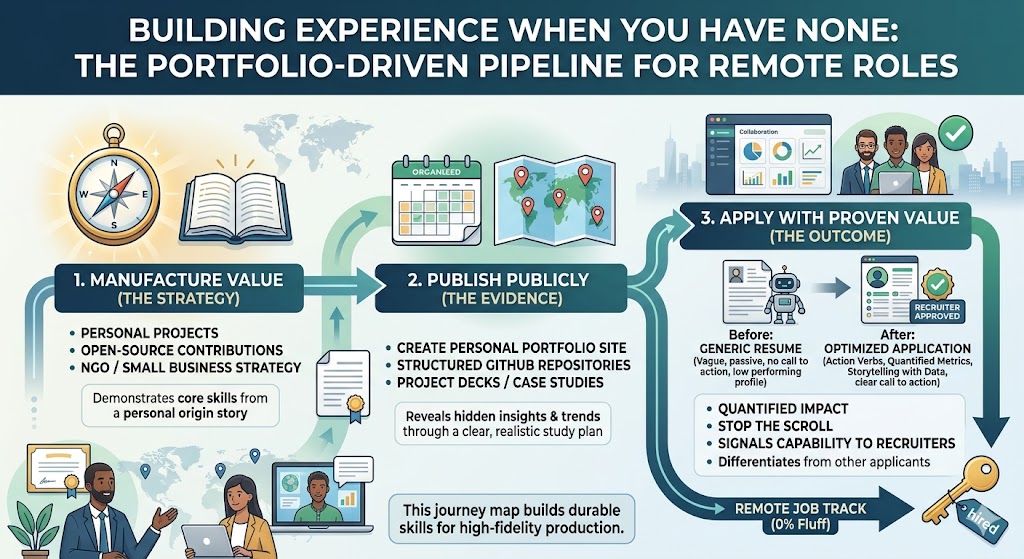
- Build Publicly: Create personal projects, redesign existing apps, or write deep-dive mock marketing strategies and host them on a personal portfolio site or GitHub.
- Contribute to Open Source: For developers, resolving minor bugs or writing documentation for open-source software proves you understand real-world team collaboration and code review pipelines.
- The NGO Hack: Offer your digital skills to a local NGO, charity, or small local business for free in exchange for a real operational brief, a tight deadline, and a glowing professional recommendation letter or LinkedIn testimonial.
Three months of intentional, proactive portfolio building creates a significantly more compelling application than two years of blasting out generic resumes with nothing to show for it.