The Fulbright Foreign Student Program is one of the most prestigious and widely recognized scholarship programs in the world. Funded by the United States government, it provides full funding for international students to pursue Master’s degrees or PhD research at American universities — covering tuition, living expenses, flights, and health insurance.
For students from the Arab world, Fulbright represents a rare combination: American university quality, full financial coverage, and the legitimacy of a US government-backed credential. Understanding exactly how the selection process works — and how to position yourself strategically — dramatically increases your chances of success.
What Fulbright Actually Covers
- Full Tuition: Complete coverage at an accredited US university.
- Monthly Living Stipend: Varies by city and program, typically $1,500 – $2,500/month.
- Travel & Allowances: Round-trip international airfare, health insurance, and supplemental allowances for books and settling in.
Who Is Eligible?
Each country has a bilateral commission (like Amideast across the MENA region or the Binational Fulbright Commission in Egypt) that administers the program locally. Generally, you must meet these criteria:
- Citizenship: Hold citizenship of the country through which you are applying (U.S. citizens or permanent residents are strictly ineligible).
- Degree Status: Hold a Bachelor’s degree before the scholarship start date.
- Language Skills: Demonstrate sufficient English proficiency (TOEFL iBT, IELTS, or Duolingo scores are standard requirements).
- Residency Limit: Must not have lived in the United States for more than five of the last six consecutive years.
How the Selection Process Actually Works
Most applicants focus entirely on their academic record. While a strong GPA matters, it is far from the only factor. Selection panels look for dynamic traits that test scores cannot show:
- Clear Academic Focus: A compelling, tightly defined vision of what you intend to study and why.
- Leadership & Impact: Concrete evidence of leadership potential and community involvement in your home country.
- The Return Plan: A credible, structured vision for how you will leverage your American university experience to benefit your home community after graduation.
Writing a Strategic Personal Statement
The personal statement is where most applications are won or lost. A common mistake is writing a statement that reads like a chronological resume—listing achievements without giving the committee a reason to care about your specific story.
A successful Fulbright personal statement must do three things:
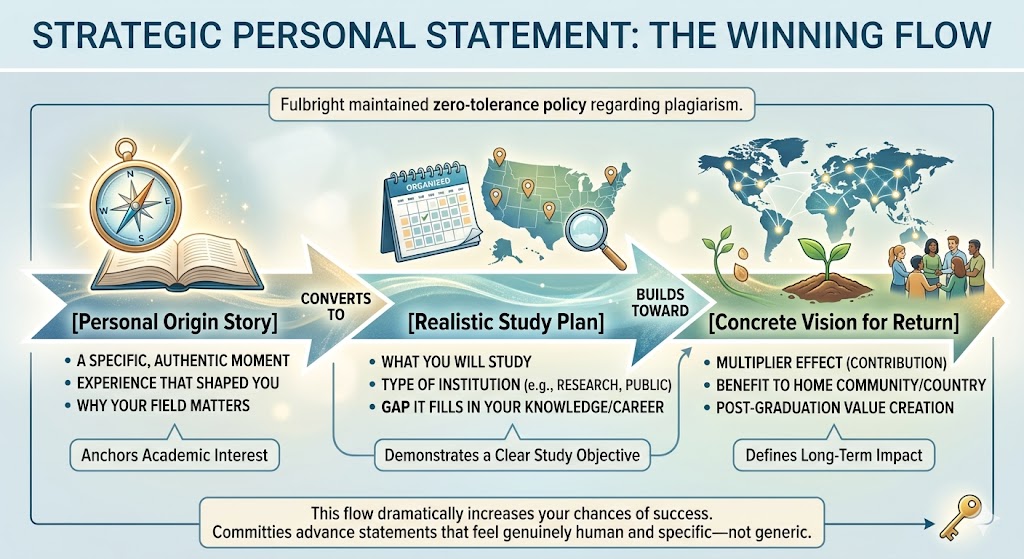
- The Anchor: Connect your academic interest to a specific, authentic experience or a localized problem you want to solve.
- The Blueprint: Articulate a clear study objective—what you want to learn, at what type of institution, and how it fills your professional gaps.
- The Multiplier Effect: Explicitly define how your return to your home country will create value for your local professional or academic ecosystem.
Important Note: Fulbright maintains a strict zero-tolerance policy regarding plagiarism. Copying lines from online essay templates, AI-generated content, or past essays will result in immediate disqualification. Keep your narrative entirely human and specific.
Choosing the Right References
Fulbright requires two to three letters of recommendation. A common trap is seeking a generic letter from a prominent professor or manager who barely knows you. Instead, look for:
- Referees who can speak directly to your analytical capacity, resiliency under pressure, and aptitude for graduate-level research.
- Supervisors who worked closely with you on significant milestones.
The Strategy: Share your personal statement and study objectives with your referees early. Give them at least four weeksto write a nuanced, detailed letter that aligns with your overall application narrative.
Application Timeline & Persistence
Because application windows generally close around May to June across the Arab world for programs starting the following academic year, a 12-month reverse timeline is critical.
If you receive a rejection letter, remember that Fulbright acceptance rates typically hover between 10% and 25%depending on regional quotas. Many current Fulbright scholars were successful only on their second or third attempt. Review your essays, update your portfolio with recent achievements, and apply again with a refined strategy.